Wordpress Too Many Failed Login Attempts. Please Try Again in 12 Hours No Plugin
More than 70% of the near popular WordPress sites on the net are decumbent to attacks . Bad news, right? Well, here is the skilful news: your website tin be among the other 30% – if merely you can follow simple WordPress security rules. You may start by limiting login attempts on your WordPress site. Here'south why.
By default, WordPress allows a user to try as many passwords as possible when logging in. While this is convenient, a bot or human hacker can exploit this. Beginning, they use a trial-and-mistake method to get your username/countersign combination. And then, they pause into your website. Information technology's called a brute force assault.
How can y'all prevent this kind of attack? Information technology's piece of cake – merely limit the number of failed login attempts in WordPress. Allow's testify you how.
Content
- How to limit login attempts using a plugin
- WordPress Limit Login Attempts Without a Plugin
- How to Disable Limit Login Attempts in WordPress
- Why should y'all limit login attempts?
- Pros and cons of limiting login attempts
- More than WordPress security tips
- Conclusion
How to Limit Login Attempts Using a Plugin
The easiest way to limit login attempts in WordPress is by using the 'Limit Login attempts Reloaded' plugin. The plugin works by detecting bots, locking out users later several failed attempts, blocking IP addresses temporarily, and notifying you when a user is locked out.
We'll employ this plugin for the following reasons:
- It is used actively on over ane 1000000 websites.
- The plugin gets regular updates.
- It is tested with the latest WordPress version.
- Has an impressive 4.ix/5 star rating.
- It is absolutely gratis.
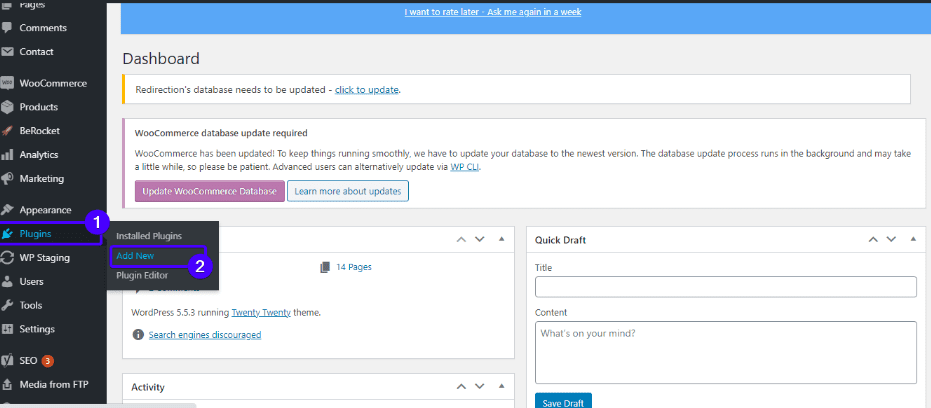
To go started with the 'Limit Login Attempts Reloaded' plugin, navigate to ' Plugins >> Add together New ' on your WordPress dashboard.
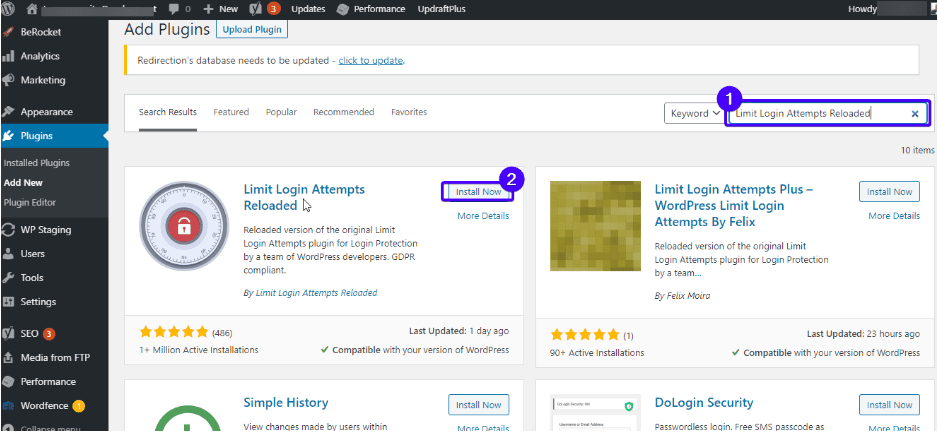
Type ' Limit Login Attempts Reloaded ' in the search bar. Side by side, click the ' Install Now ' tab right side by side to the plugin.
After installation is complete, click 'Activate' . At present, y'all have the plugin fully working. It's fourth dimension to configure information technology.
To exercise this, go to ' Settings >> Limit Login Attempts '.
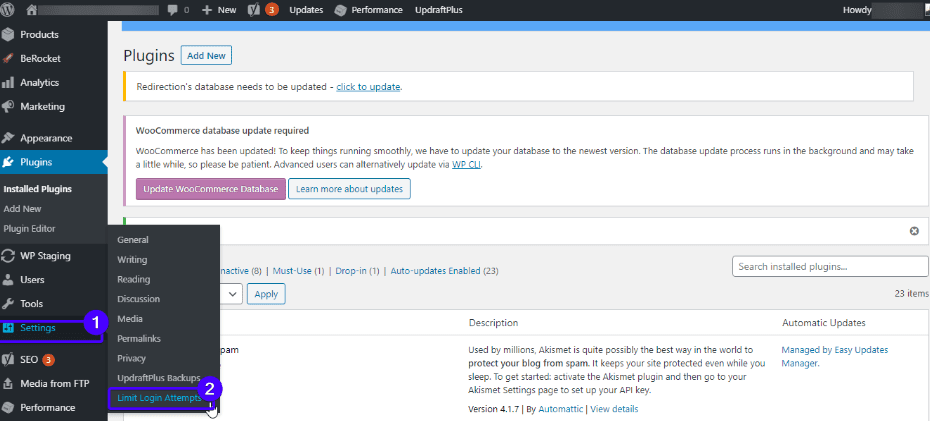
This will take you to the plugin settings page.
In the ' General Settings ' section, y'all tin dis/enable GDPR compliance (for information protection). Also, yous tin can enter the email to which notifications are sent after lockouts.
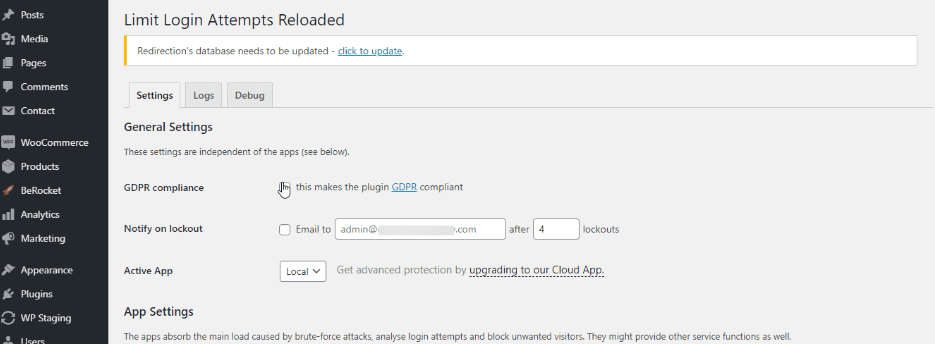
In the ' App Settings' section, set how many login attempts are allowed earlier a user is locked out. You tin also determine how long a user stays locked out.
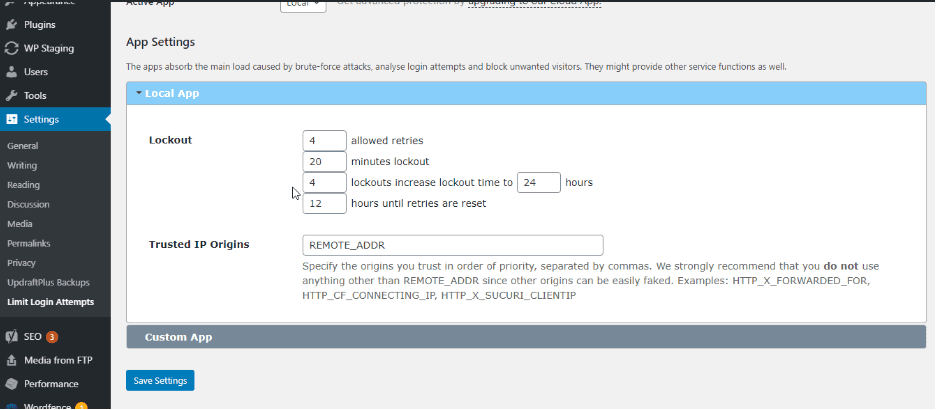
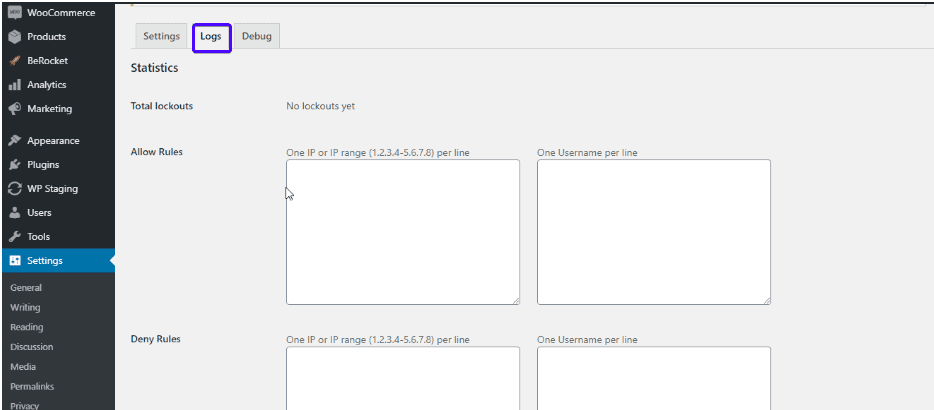
The ' Logs ' tab allows you to enter IPs and/or usernames. Whatever IP or username you allow can log in as many times as possible without existence locked out.
On the other hand, any IP or username you deny will be locked out permanently. This is particularly important when you detect suspicious activities coming from an IP address.
After making all settings, don't forget to hit the ' Salve Changes ' tab.
At that place you go! You lot have successfully limited login attempts on your WordPress site.
WordPress Limit Login Attempts Without a Plugin
If you are ane of the WordPress users with a phobia for plugins, you can limit login attempts manually. But, earlier you take this pace, do well to support your website . Yous can employ any of our top WordPress backup plugins . This will prevent the loss of your precious site's content.
In one case you have your most recent WordPress backup, connect to your website via FTP. Open the public_html folder (or wherever your WordPress files are). Then, navigate to wp-content >> themes.
Open up your active theme'south binder and locate the part.php file. Right-click on the file and select edit. When it opens, insert the following code into the file.
Code – Limit Login Attempts in WordPress
if ( get_transient( 'attempted_login' ) ) {
$datas = get_transient( 'attempted_login' );
if ( $datas['tried'] >= 3 ) {
$until = get_option( '_transient_timeout_' . 'attempted_login' );
$time = time_to_go( $until );
return new WP_Error( 'too_many_tried', sprintf( __( '<potent>Mistake</strong>: You have reached authentication limit, yous volition be able to endeavour again in %1$southward.' ) , $fourth dimension ) );
}
}
render $user;
}
add_filter( 'cosign', 'check_attempted_login', thirty, 3 );
part login_failed( $username ) {
if ( get_transient( 'attempted_login' ) ) {
$datas = get_transient( 'attempted_login' );
$datas['tried']++;
if ( $datas['tried'] <= 3 )
set_transient( 'attempted_login', $datas , 300 );
} else {
$datas = array(
'tried' => 1
);
set_transient( 'attempted_login', $datas , 300 );
}
}
add_action( 'wp_login_failed', 'login_failed', ten, i );
function time_to_go($timestamp)
{
// converting the mysql timestamp to php time
$periods = array(
"second",
"minute",
"hour",
"twenty-four hours",
"calendar week",
"month",
"year"
);
$lengths = assortment(
"60",
"60",
"24",
"7",
"4.35",
"12"
);
$current_timestamp = time();
$deviation = abs($current_timestamp – $timestamp);
for ($i = 0; $difference >= $lengths[$i] && $i < count($lengths) – 1; $i ++) {
$difference /= $lengths[$i];
}
$difference = round($deviation);
if (isset($difference)) {
if ($difference != i)
$periods[$i] .= "s"; $output = "$difference $periods[$i]";
Finally, save changes .
If you have followed the process accordingly, users with 3 failed login attempts will be locked out (for a period of fourth dimension).
How to Disable Limit Login Attempts in WordPress
Since you have known how to limit login attempts in WordPress, information technology makes sense to learn how to disable it.
If you take used a plugin to limit the login attempts, simply conciliate, or uninstall the plugin. But, if you used code to limit login attempts, and so carefully remove the lawmaking.
If y'all Don't Limit Login Attempts in WordPress, What Happens?
Outset, allow's discuss WP website security issues more often than not.
Millions of sites have been hacked in contempo years. Alarming, right? Well, as you know, there's no smoke without burn. At that place is a reason why WP sites get hacked. Unupdated plugins, wrong file permissions, poor hosting, are simply a few.
Visualize the facts in this chart (based on research past wordfence ).
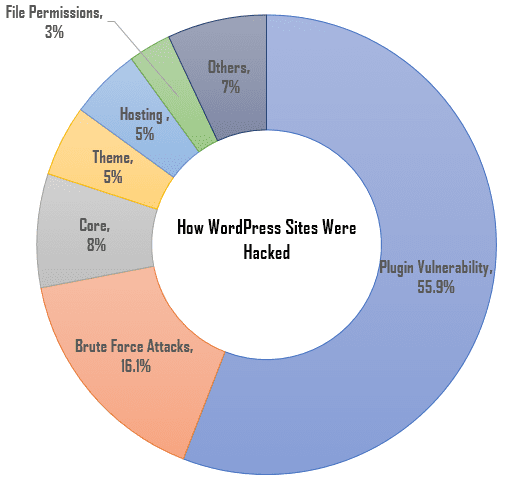
Virtually threescore% of WP security troubles were a result of plugin vulnerability.
Most probable, owners of the sites used questionable or nulled plugins, or they didn't update the plugins regularly.
Understandably, keeping your WordPress site upward to date and maintaining it may be the last thing on your mind. It'southward still not enough reason to expose your website.
Our WordPress maintenance programme covers site & plugin updates, cloud backups, speed optimization, and troubleshooting errors. Subscribe to a plan and focus on growing your business organization.
That said, the second-largest attacks on WordPress sites were brute forcefulness attacks (sixteen.1%). This ways cybercriminals were able to intermission into websites past making right username/password guesses.
When a hacker breaks into a website through this means, s/he can:
- Accept over your website.
- Redirect your visitors to unsafe websites.
- Deface your website.
- Lure your visitors into downloading malware.
- Promote illegal stuff in your name.
- Steal customer's information.
- Inject malware into your site.
When any of these happens, y'all'll lose reputation non just with your customers but with Search Engines. So, do everything yous tin can to discourage hackers from logging in to your WordPress website.
When you limit login attempts, just users who know the password for sure will gain access to your website. Another user who depends on a trial-and-fault method will be locked out after a few failed login attempts.
Pros and Cons of Limiting Login Attempts in WordPress
Limiting login attempts in WordPress has its good side, but in that location are a few undesirable sides, as well.
Pros
The major advantage of limiting login attempts is that it prevents bots and humans from breaking into your WordPress weblog or site (we stated this already). This is useful even if you have a difficult-to-guess password.
Also, it prevents undue pressure on your server. When a hacker enters too many passwords on your website within a brusk span, the pressure on your server increases. Consequently, speed and performance suffer. You lot don't want that.
Locking out a hacker temporarily is unremarkably enough to discourage further login trials. They just move on to the next website.
Cons
Genuine users may exist locked out too if they have multiple failed login attempts. This is quite inconvenient. However, you can solve this problem by whitelisting all known WordPress users, so they never become locked out.
Secondly, the easiest method of limiting login limits involves a plugin. Although the plugin is lightweight in itself, quite a number of WordPress users frown at its use.
To solve this, you lot may apply an alternative method by editing your theme's part.php file.
More than Security Tips
Limiting login attempts is just one part of WordPress security. In that location are other security tips to help you lot keep hackers at bay. Hither are another tips:
Use Strong Passwords
Your password is the gate to your website. If it'south weak, anyone (wanted and unwanted) can walk in with no resistance. If it's strong, only legitimate users are likely to go far. And so, as much as you can, employ a stiff countersign. We tin't stress this enough.
A study by NordPass revealed that over ii.five one thousand thousand websites use '123456' equally passwords. And, guess what! It takes less than i second to scissure it.
Your password should be a unique one consisting of numbers, special characters, and a mix of lower and upper cases. If this sounds like too much work, you tin can use a password generator tool to salvage you the stress.
Too, change your username from the default 'admin' to a stronger name.
Change your WordPress salts and Security keys
When you log in, WordPress stores your username and password in cookies. This means y'all wouldn't have to enter your login data when adjacent y'all visit.
While this is helpful, information technology could open up you up to security issues. To solve this, use WordPress salts and security keys. They encrypt your login information. Such that, your password does not appear in apparently text simply in an incomprehensible cord of characters.
Now, changing the keys could give your website an extra layer of protection. See our commodity on WordPress salts to learn more nearly their benefits and how to change them.
2-factor hallmark
This is a security procedure in which a WordPress user is given access to a website merely afterwards providing 2 authentication factors. It is another mode of preventing fauna forcefulness attacks.
Once you set it up, you'll receive a code on your phone anytime you log in.
This hallmark method works well specially when it's coupled with a stone-solid password.
Practice a Regular Malware Scan
A regular scan helps to detect malware in your website before information technology affects your website. The easiest way to check for malware on your website is by ordering our WordPress malware scanning service .
Y'all should besides consider using a good WordPress hosting provider and a great security plugin.
WordPress Updates
We already mentioned that the highest crusade of security breaches in WordPress is plugin vulnerability. K eeping your WP core, plugins, and themes updated is key. Uninstall plugins and themes yous don't need.
This way, yous'll not simply have the latest security feature installed on your website, you'll also salve yourself unnecessary headaches.
Avoid Nulled Plugins or Themes
Nulled WordPress themes and plugins are pirated copies of the original. They are distributed at ridiculously cheap prices or even given out for free.
When used, they can compromise your site'southward security.
Employ But a Recommended WordPress Host
WordPress has not left u.s. in the night. The requirements of a WordPress host are clearly spelled out.
To run your WordPress site well, a web host must back up PHP version 7.4 or greater, MySQL version v.6 or greater, or MariaDB version ten.1 or greater. It must also support HTTPS.
Using a host that lacks this requirement will expose your website to attacks.
Not using SSL document
Information sent over a website with no SSL is exposed. This means data can exist stolen and used for illegal purposes. An SSL certificate encrypts your data and prevents hackers from laying hands on your information.
Weak User role practices
WordPress has 5 user roles: Administrator, Editor, Author, Correspondent, Subscriber. This means you lot tin can restrain users according to their roles. For instance, an writer can write a mail service but cannot delete posts or add users. An editor can do nothing except edit.
Anyone with Administrator privileges, on the other hand, has unrestricted access to edit, modify, add users, delete posts, etc .
Conclusion – WordPress Limit Login Attempts
Even though we trust WordPress developers to keep the platform secure, yous nevertheless take your role to play. One of which involves putting a login attempts limit to preclude illegal admission to your WordPress admin console.
Have you tried limiting login attempts on your WordPress site? Let us know how it went in the comments below.
Please cheque out the balance of our blog for other WordPress tutorials.
Read More than Useful Articles:
mackeyinglacrievor39.blogspot.com
Source: https://www.fixrunner.com/how-to-limit-login-attempts-in-wordpress/
0 Response to "Wordpress Too Many Failed Login Attempts. Please Try Again in 12 Hours No Plugin"
Enregistrer un commentaire